
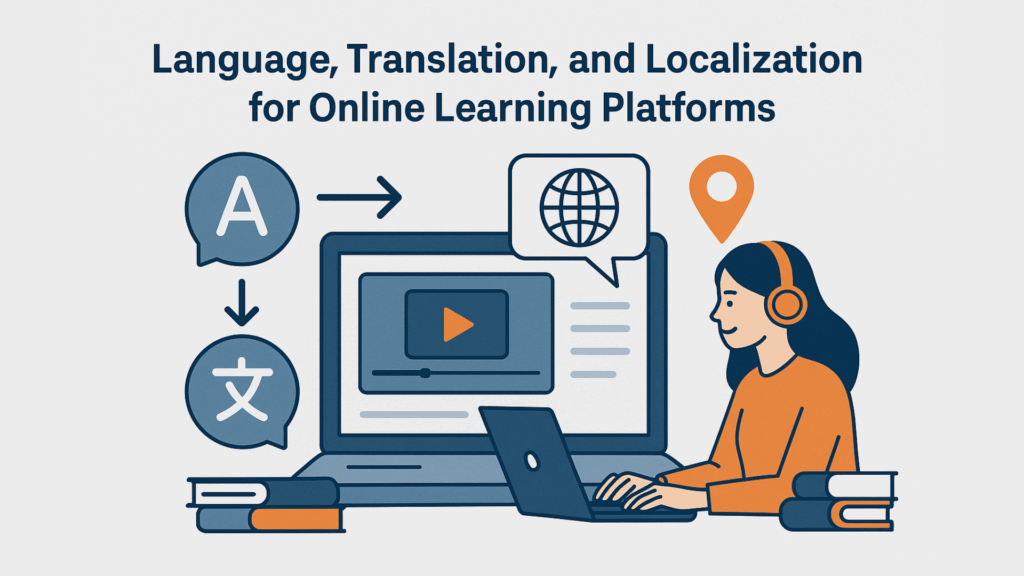
Building an online learning website goes far beyond creating an attractive catalog of courses. In today’s global digital economy, learners come from various regions, cultures, and backgrounds, and they prefer to consume content in their own language. This is where language, translation, and localization play a crucial role in shaping the learner’s experience. From the learning website’s interface to the actual course content, delivering a multilingual and localized experience ensures accessibility, inclusivity, and learner success.
Why Language Matters in Online Learning
Language is the gateway to understanding and knowledge. If learners encounter a platform that only supports one language, they may feel excluded or struggle to engage with the learning material. Online learning is not just about providing content—it is about enabling seamless learning journeys for a global audience. Making a learning environment multilingual and localized is fundamental to ensuring everyone has equal opportunities to benefit from educational content.
The Two Levels of Translation and Localization
Translation and localization in eLearning involve two distinct but equally important layers:
Localizing the Learning Website and LMS
The first layer is the learning management system (LMS) or the broader online learning website. This is where learners register, explore course catalogs, track progress, and interact with their dashboards. For a global platform, every element of this interface, including menus, actions, notifications, and dashboard information, must be localized.
A well-designed system must allow learners to select their preferred language easily. Once chosen, the website dynamically adapts, presenting the interface and supporting elements in that selected language. This ensures a truly personalized and inclusive learning environment.
Localizing the Course Content
The second layer of translation focuses on the course content itself. This includes text, videos, assessments, interactive activities, and supporting resources. Learners should have the option within each course to select their preferred language. Once selected, the course should dynamically present all pages and modules in that language, providing a consistent and accessible experience throughout the learning journey.
Both layers—website interface and course content—are equally important to ensure full accessibility for global learners.
Using AI to Support Translation and Localization
AI has become a game changer in eLearning translation, offering speed, cost efficiency, and scalability. But to be truly effective, AI should be integrated into the authoring process rather than only applied dynamically.
When content teams translate during authoring, they avoid repeated costs that occur when translations are performed dynamically every time a learner accesses a course. This proactive approach ensures that multilingual versions exist before the course is published, and learners access their preferred language instantly without overhead translation charges.
AI-driven translation tools can also speed up the localization workflow by handling large amounts of text, multimedia captions, and interface labels. However, AI is not perfect, and idioms, cultural nuances, or technical content may not be conveyed accurately. That’s why a human review is essential to refine AI-generated translations, ensuring they are contextually correct and culturally appropriate.
By combining AI efficiency with human expertise, course providers can strike the perfect balance between scalability and quality.
Challenges and Best Practices for Course Localization
When creating multilingual eLearning platforms, organizations often face challenges such as maintaining consistent terminology across translations, synchronizing audio/video content with text, and ensuring technical accuracy. Best practices to address these challenges include:
- Building a terminology glossary that remains consistent across all languages.
- Using AI to generate first-level translations while involving human subject-matter experts to ensure quality.
- Authoring courses in a modular format so that translations can be updated easily.
- Testing the learner experience in multiple languages to confirm smooth navigation.
Unlocking a Multilingual Future with Instancy
Delivering effective and engaging multilingual learning experiences requires the right tools and processes. With Instancy, you can set up a complete learning platform for your internal team or customer education, supporting multiple languages seamlessly. Instancy provides a non-programming interface to add languages, design multilingual learning websites, and deliver personalized dashboards.
For course developers, Instancy offers comprehensive authoring tools to create multilingual content. With built-in generative AI integration, authors can translate, review, and refine content during the course development stage. This allows learners to access high-quality localized courses immediately in their chosen language.
By combining AI translation with human review, Instancy empowers organizations to deliver inclusive, accessible, and cost-effective learning experiences under a single platform.
Get started today with Instancy.ai to create your multilingual online learning platform—empowering global learners with accessible courses, personalized dashboards, and comprehensive content delivery in multiple languages.


 English
  Arabic