
Introduction
An online course has traditionally been either a self-paced e-learning module or a live virtual classroom session. However, learning designers today recognize the tremendous power of combining multiple modalities into one seamless program—what is now called a blended learning path. This approach brings together the flexibility of self-study and the interactivity of instructor-led training, ensuring that learners receive guidance from experts while still progressing at their own pace.
Blended learning is not just about mixing formats, but about strategically sequencing different learning experiences—such as pre-learning, collaborative sessions, assessments, and certifications—into one coherent journey that maximizes engagement and effectiveness. Instancy.ai enables organizations to easily design and deliver these blended paths in a scalable, personalized, and measurable way.
Why Blended Learning Matters
A blended approach enriches both the learner’s journey and the instructor’s role. By combining self-paced learning with instructor-led sessions—whether through physical workshops or virtual classrooms—learners are better prepared to use their time with facilitators meaningfully. For instance, providing e-learning modules before a collaborative live session ensures that all participants arrive with baseline knowledge. This way, the instructor’s time can be spent deepening understanding, engaging in discussions, and solving real-world problems rather than covering basic concepts.
Learners benefit from the flexibility of consuming content when it suits them, but also gain from live interaction, guidance, and peer collaboration. Organizations benefit from higher engagement, better learning retention, and more efficient use of teaching resources.
Components of a Blended Learning Path
A well-structured blended learning path consists of several layers that reinforce each other. Using Instancy.ai, instructional designers can integrate:
- Self-paced modules: Foundational e-learning courses that learners can complete anywhere and anytime. These deliver core knowledge in digestible formats like videos, readings, or interactive exercises.
- Instructor-led sessions: Live workshops or virtual classrooms where learners engage directly with experts for group discussions, problem-solving, and clarification.
- Pre-tests: Short assessments at the start of the course that identify a learner’s baseline knowledge and help customize their path.
- Post-tests: Comprehensive evaluations after each module or at the end of the course to measure knowledge gains.
- Periodic assessments: In longer programs, assessments can follow each module to ensure learners are not only consuming content but actually mastering it.
- Learner surveys: Post-course surveys provide valuable feedback on the learning experience, content relevance, and instructor effectiveness, helping improve future programs.
- Certificates: Upon successful completion, learners receive a certificate customized with their name, course title, completion date, and even expiration date. This recognition provides tangible proof of achievement that can be shared professionally.
Sequencing the Learning Path
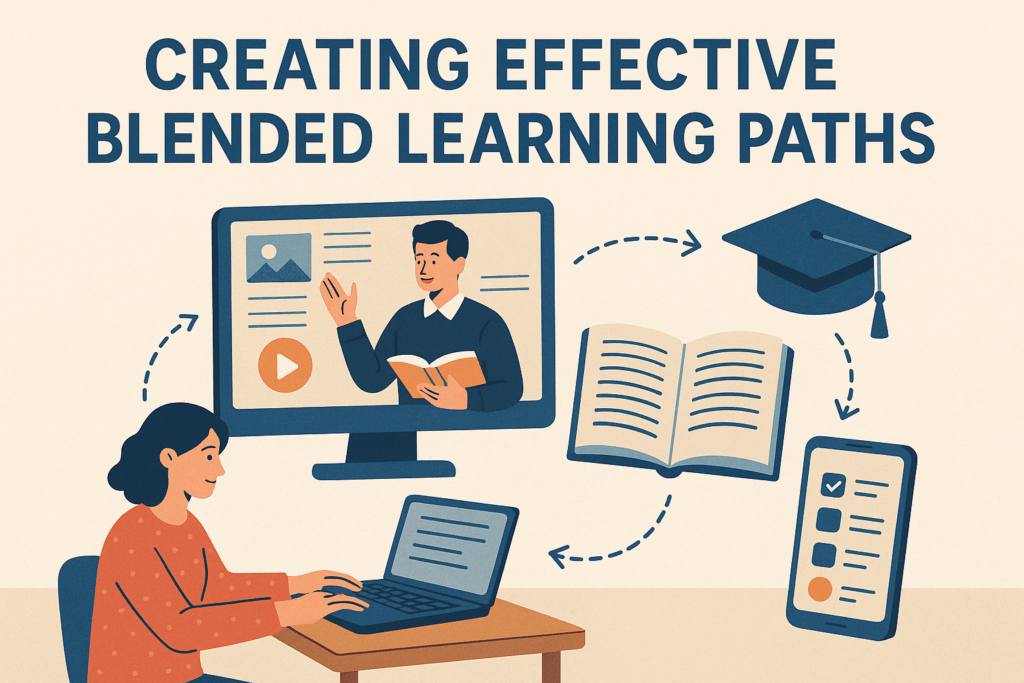
The key to blended learning success lies in its sequence. A typical design may follow this order:
- Diagnostic pre-test to assess knowledge gaps.
- Self-paced learning modules that provide fundamental concepts.
- Instructor-led training (virtual or physical) for collaborative engagement and expert guidance.
- Post-tests and periodic assessments to track learning effectiveness.
- Learner surveys to gather input about the experience and quality of content.
- Certificate of completion with personalized details for motivation and recognition.
This structured flow ensures that learners start at the right level, progress systematically, and gain practical knowledge that is reinforced through assessments and feedback.
Building Blended Learning Paths with Instancy.ai
Instancy.ai makes it seamless to design, deliver, and manage blended learning paths. Learning designers can create paths that integrate both digital and live modalities into a single user-friendly framework. With built-in tools, they can:
- Design pre-tests and assessments for every module.
- Blend e-learning courses with virtual classrooms or workshops.
- Automate the issuance of branded, customizable certificates.
- Collect learner feedback through integrated surveys.
- Track learner progress, completion, and performance using analytics.
This creates a scalable, personalized experience where learners are motivated, instructors are empowered, and organizations can measure the impact of training initiatives.
Conclusion
Blended learning is no longer just an option but a necessity for modern training and education. By combining self-paced courses with collaborative instructor-led training, pre- and post-assessments, learner feedback mechanisms, and certification, a learning path becomes more engaging, effective, and results-driven.
With Instancy.ai, organizations can design and manage these blended learning paths with ease, delivering measurable impact on both learners and business objectives.
Ready to create your own blended learning paths? Discover how Instancy.ai can transform your training programs into engaging, effective, and scalable learning journeys. Connect with us today to get started. Would you like me to make this article more marketing-style (storytelling about learner benefits) or more instructional (step-by-step guide for designers)?


 Arabic
  English