
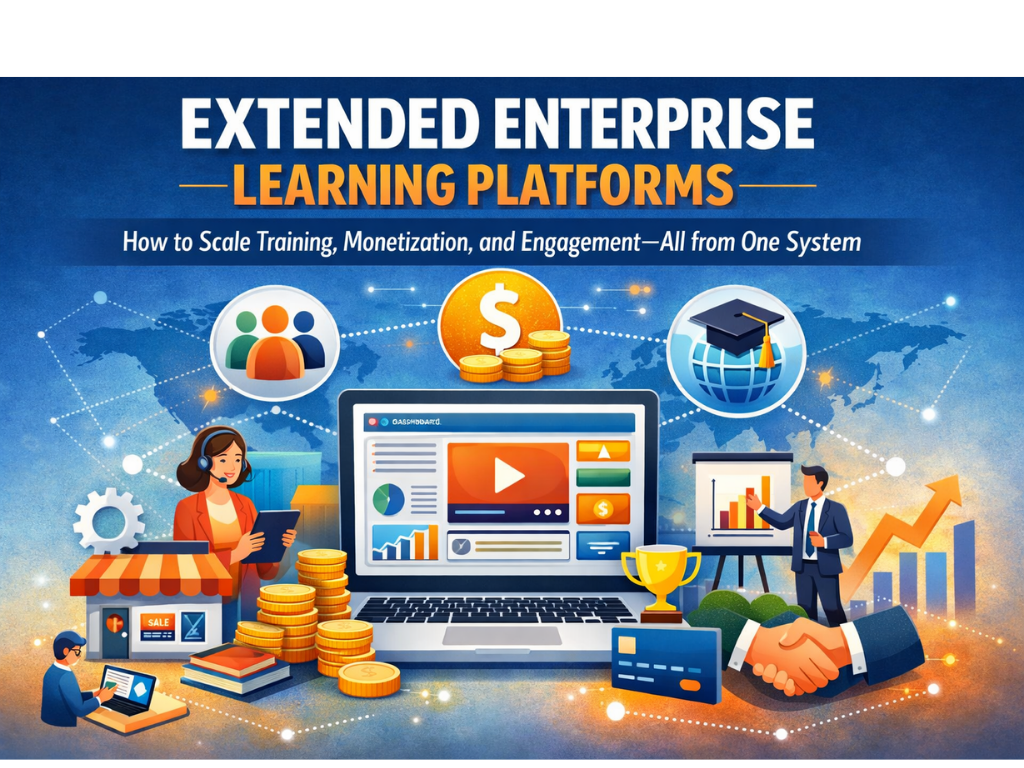
Organizations today no longer train just employees.
They train customers, partners, resellers, franchisees, contractors, and professional communities. In many cases, training itself has become a product—something that drives revenue, loyalty, adoption, and long-term value.
This shift has given rise to Extended Enterprise Learning Platforms: learning systems designed to support both internal workforce development and external, revenue-generating education—at scale.
However, succeeding with extended enterprise learning is not simply a matter of “using one LMS for everything.” It requires deliberate design across workflows, content strategy, technology architecture, monetization, analytics, and AI.
This article explains:
- What extended enterprise learning really is
- Common use cases and challenges
- Best practices for successful implementation
- How modern AI-powered platforms enable scale, efficiency, and growth
What Is an Extended Enterprise Learning Platform?
An extended enterprise learning platform goes beyond traditional employee training. It is designed to serve multiple audiences, each with distinct needs, motivations, and access models—while still being managed from a centralized system.
Typical audiences include:
- Internal employees and managers
- Customers and end users
- Channel partners and resellers
- Franchise owners and staff
- Independent professionals and learners
- Paid subscribers or members
The platform must support:
- Different branding and user experiences
- Separate catalogs and pricing models
- Shared content and administration
- Integrated eCommerce and analytics
In essence, extended enterprise learning transforms training from a cost center into a strategic growth engine.
Core Use Cases for Extended Enterprise Learning
1. Internal Workforce Enablement
Organizations still need robust internal learning:
- Onboarding and role-based training
- Compliance and certification
- Continuous upskilling
- Knowledge sharing and collaboration
But internal training increasingly benefits from:
- Microlearning instead of long courses
- AI tutors and on-demand guidance
- Learning embedded into daily workflows
2. Customer and Partner Education
Externally, learning supports:
- Product adoption and faster time-to-value
- Reduced support costs
- Partner readiness and sales enablement
- Customer loyalty and retention
Well-designed education ecosystems often outperform traditional documentation and support portals.
3. Monetized Learning and Digital Products
Many organizations now sell:
- Courses and certifications
- Workshops and virtual classrooms
- Memberships and subscriptions
- Mobile learning apps
- Premium AI-powered learning experiences
This requires learning platforms to function like modern digital commerce systems, not just LMSs.
Designing for Success: Key Implementation Principles
1. Optimize and Share Workflows Across Audiences
One of the biggest mistakes in extended enterprise learning is duplicating effort.
A successful platform allows you to:
- Use one shared admin and authoring workflow
- Reuse content across internal and external audiences
- Apply different rules, branding, and pricing without recreating assets
Training administrators should be able to:
- Create once
- Publish many times
- Customize access, visibility, and monetization
This dramatically reduces operational overhead while increasing consistency and quality.
2. Leverage Shared Content—Without Losing Control
Extended enterprise platforms must strike a balance:
- Centralized content management
- Audience-specific delivery
Best practices include:
- A single content repository
- Flexible tagging and role-based access
- Version control across sites
- Audience-specific learning paths
For example:
- The same core product module may be used internally for onboarding
- Externally, it may be adapted into a paid course, microlearning series, or AI tutor
This approach protects institutional knowledge while maximizing reach and ROI.
3. Use Multi-Site Architecture with High Customization
Extended enterprise learning almost always requires multiple sites.
Each audience expects:
- Its own branding and domain
- A tailored user experience
- A relevant catalog and messaging
An effective platform supports:
- Multiple sites and tenants from one backend
- Custom domains and branding
- Configurable navigation, layouts, and features
- Separate pricing and access models
This is especially critical when learning is customer-facing and revenue-generating.
4. Build External Learning Sites That Attract Visitors
External learning portals are not just training systems—they are digital destinations.
They must be:
- SEO-friendly
- Content-rich
- Optimized for discovery and conversion
This means supporting:
- Public-facing pages and catalogs
- Search engine indexing
- Structured content for discoverability
- Landing pages for campaigns and offerings
Learning platforms that ignore SEO limit growth before learning even begins.
Supporting Modern Learning Content and Experiences
Extended enterprise learners expect more than static courses.
Multiple Content Types Matter
Successful platforms support:
- Video tutorials and walkthroughs
- Interactive simulations and software demos
- Microlearning and spaced learning
- Assessments and certifications
- Adaptive learning paths
AI-Powered Learning Experiences
AI is no longer optional.
Modern extended enterprise platforms increasingly include:
- AI tutors that answer questions conversationally
- Adaptive learning that adjusts to learner progress
- AI-generated microlearning from documents, presentations, and web content
- Role-based recommendations and learning automation
AI dramatically improves scalability, personalization, and engagement—especially across diverse external audiences.
Mobile Learning, Microlearning, and In-App Monetization
External learners are mobile-first.
Extended enterprise platforms must support:
- Responsive web learning
- Native iOS and Android apps
- Offline access where needed
- Push notifications and reminders
For monetized learning, mobile introduces additional opportunities:
- In-app purchases
- Mobile subscriptions
- App store distribution
- Microlearning-based pricing models
Mobile learning is not just a delivery channel—it is a growth channel.
eCommerce Integration Is Not Optional
Extended enterprise learning often involves revenue.
A modern platform must support:
- Course and program sales
- Subscriptions and memberships
- Bundles and promotions
- Multiple payment gateways
- Tax and currency support
Importantly, eCommerce should be native, not bolted on.
Analytics That Go Beyond Completion Rates
Traditional LMS reporting is insufficient.
Extended enterprise platforms must provide:
- Learning progress and engagement dashboards
- Audience-level insights across sites
- Content effectiveness metrics
And critically:
- eCommerce analytics
- Revenue by course, audience, and channel
- Conversion and retention metrics
Training leaders need visibility not just into learning outcomes—but into business outcomes.
The Role of AI in Extended Enterprise Learning Platforms
AI enables what manual systems cannot:
- Scale personalization across thousands of learners
- Automate content creation and adaptation
- Provide real-time support without increasing staff
- Optimize learning paths and recommendations
AI transforms extended enterprise learning from a static system into a living, evolving learning ecosystem.
Bringing It All Together with Instancy.ai
Instancy.ai is designed specifically to support extended enterprise learning at scale—combining:
- Centralized learning management
- Multi-site and multi-audience delivery
- AI-powered content creation and tutoring
- Native eCommerce and mobile learning
- Rich analytics for learning and revenue
- Flexible branding, customization, and workflows
Whether you are:
- Training employees and customers
- Monetizing knowledge and expertise
- Building learning communities
- Scaling education as a business
Instancy.ai provides the foundation to do it from one unified AI learning platform.
Start Your Extended Enterprise Learning Journey
Extended enterprise learning is no longer a future concept—it is a competitive necessity.
The question is no longer whether to extend learning beyond employees, but how effectively you do it.
👉 Start a free trial of Instancy.ai, the AI-powered extended enterprise learning platform, and explore how you can scale learning, engagement, and revenue—without complexity.


 Arabic
  English