
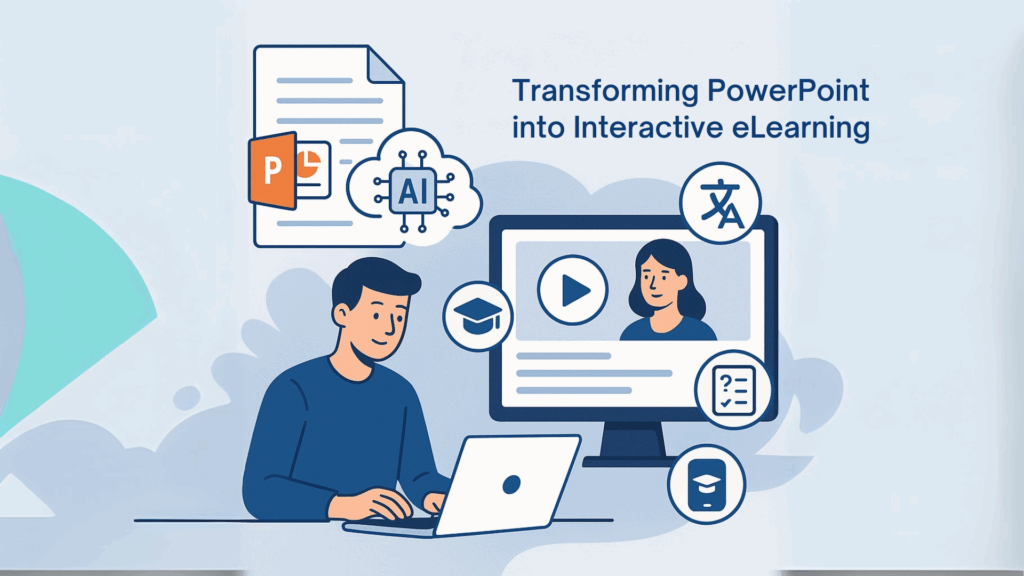
The Challenge: From Content Overload to Meaningful eLearning
Instructional designers and corporate learning teams are often faced with a paradox: there’s a massive abundance of valuable content—think slide decks, presentations, and training documents—yet transforming this material into effective eLearning is both time-consuming and laborious. Managing and converting large volumes of static PowerPoint slides into interactive, engaging formats can be incredibly resource-intensive. Key pain points include:
Endless hours spent reformatting slides into online modules.
Limited template options, restricting the ability to add fresh interactivity.
Manual creation of multimedia elements and quizzes.
Slow localization and translation workflows for global teams.
Difficulty integrating conversational or supplemental materials.
Efforts required for mobile optimization, branding, and compliance with eLearning standards like SCORM.
The need for ongoing updates, manual edits, and content review cycles.
Why Businesses and L&D Teams Need AI-Powered Transformation
Organizations—including businesses, training academies, and learning & development departments—rely on rapid, cost-effective upskilling. Converting existing presentations into eLearning offers clear value:
Accelerated Content Production: AI-driven systems can import PowerPoint slides, understand layouts using computer vision, and create web-based, interactive eLearning pages in minutes—not weeks.
Engagement Boost: Integrations with generative AI and agent technologies allow the addition of click-to-reveal interactions, mini activities, simulations, and multimedia enhancements.
Localization & Accessibility: Instantly translate materials and add narration in multiple languages, supporting global learners.
Built-in Assessments: Automated generation of quizzes or knowledge checks, reducing manual question design.
Conversational Agents: Add AI tutors directly into courses for on-the-spot learner support, without any coding.
Seamless Updates and Customization: Instructional designers remain in control, guiding AI and making real-time edits as needed.
Mobile & LMS Integration: AI ensures content is responsive across devices and packages material in eLearning standards, ensuring progress tracking and analytics.
Key Terminology: Understanding Generative AI and Agentic Systems
Before diving into how modern tools work, let’s define some concepts:
Generative AI: This refers to artificial intelligence systems (like ChatGPT, Claude, or DALL-E) that create new content—such as text, images, or audio—from prompts. While powerful, these models typically generate raw outputs rather than a fully structured learning journey.
AI Agents: These are more sophisticated systems that combine different AI tools and orchestrate step-by-step processes. They can guide, review, and interact with other systems and humans, enabling more complete content development workflows.
Agentic Orchestration: This is the practice of integrating multiple AI and automation tools—under the supervision of a human “in the loop”—to turn static content into interactive learning experiences.
The Limitation of General-Purpose AI Models
It’s tempting to use raw generative AI models for building eLearning courses. However, research and practical experience show that simply generating chunks of text or single images isn’t enough for comprehensive eLearning. While you could use AI to write a lesson or produce narration, creating a complete course requires:
Organizing content into a logical, navigable structure.
Adding interactive elements, assessments, and feedback loops.
Branding and applying organizational themes.
Ensuring compliance with eLearning standards.
Maintaining content for continuous improvement.
Standalone AI models can’t do all this—what’s needed is an orchestrated workflow, where each step is managed and reviewed by intelligent systems and human experts working together.
AI Agentic Authoring: The Instancy Advantage
Instancy’s AI agent-powered authoring tool exemplifies this new approach. Here’s how it works:
Smart Conversion: Instancy uses computer vision to analyze PowerPoint layouts, automatically generating interactive learning module pages.
Enhanced Interactivity: Designers can add multimedia, interactive widgets, and quizzes with minimal effort—far beyond the limitations of old templates.
Multilanguage Support: AI streamlines translation and voiceover, making global content rollout easy.
Conversational AI: A virtual tutor can be embedded in modules, providing just-in-time support and answering questions—without coding requirements.
Human-in-the-Loop Flexibility: Designers guide AI agent workflows, reviewing and customizing outputs at every step for quality assurance.
Seamless Packaging: AI ensures final modules are mobile-friendly, branded, and SCORM-compliant for use with any major learning management system.
A True End-to-End Solution
The result: presentations become engaging, interactive eLearning modules—quickly and efficiently—with:
Structured table of contents for easy navigation.
Stylish, branded pages that reflect organizational identity.
Automated progress tracking and analytics within your LMS.
Continuous, effortless updates whenever content needs to evolve.
Call to Action
Ready to revolutionize your learning content? Experience the power of generative AI and agent-powered authoring for yourself—transform ordinary PowerPoint slides into dynamic eLearning modules in minutes. Don’t let your valuable knowledge sit unused—let Instancy’s intelligent systems do the work, elevating both learner engagement and instructional impact.
Explore what’s possible and start creating the next generation of learning today!


 Arabic
  English